Featured Post

Ellen, please be kind to the planet, not just to your fellow humans, gorillas in Rwanda

LUNCHTIME IN RWANDA: Ellen DeGeneres, right, and wife Portia de Rossi with a mountain gorilla. The Ellen DeGeneres Wildlife Fund  is supp...

Showing posts with label The Washington Auto Show. Show all posts

Tuesday, July 25, 2017

With 6,000+ unsold, new Chevy Bolt EV is shaping up to bomb like first Volt hybrid

The Chevrolet Bolt EV, the first mass-market all-electric car with a range of more than 200 miles, was shown at the New York International Auto Show in 2015.

-- HACKENSACK, N.J.

By VICTOR E. SASSON
EDITOR

General Motors once claimed the Chevy Bolt -- the first "affordable" all-electric car with a range of more than 200 miles -- would pose a significant threat to upstart Tesla.

But as Tesla ramps up production of its Model 3 sedan -- holding $1,000 deposits from more than 400,000 eager buyers -- GM has shuttered the plant that makes the Bolt. 

According to Reuters, there are now more than 6,000 unsold Bolts on hand in the United States -- or a 111-day supply (70 days is considered ideal).

"One dealer is reported to have more than 200 Bolts on its lot," the Gas2 blog reported last week.

The Achilles heel in the new EV is GM's refusal to build a dedicated nationwide network of fast electric chargers like the one owners of the Tesla Model S and Model X use for free when they are on road trips.

Free Tesla Superchargers at the Colonie Center, a mall near Albany, N.Y., with a Whole Foods Market. I can recommend the delicious Asparagus Meyer Lemon Soup.


Urban vehicle

The Bolt is being marketed as an urban or suburban vehicle that you charge overnight at home.

The EV would be ideal for seniors, whose driving is limited to grocery shopping, visits to the doctor and volunteering, but it isn't being marketed to that forgotten segment of the population.

The first-generation Chevrolet Volt, a plug-in hybrid that uses gasoline, also proved to be unpopular during its production run.

The 2011 Volt went on sale in the United States in mid-December 2010, and in the next six years, GM delivered about 113,500 -- that's less than 20,000 on average each year. 

The first-generation Volt operates as a pure electric vehicle for up to 38 miles, but then an internal-combustion engine powers an electric generator to extend the car's range.

The second-generation Volt's all-electric range was extended to 53 miles, but the sedan also needs gasoline beyond that.

Now, GM may drop the Volt in the 2020 model year and replace it with a plug-in hybrid crossover.

The automaker wants to build more high-profit SUVs and pickup trucks, which guzzle gas and say to hell with the environment.


Tesla Model 3 in blue.


Bolt appraisal

I drove a production model of the Bolt through the streets of the nation's capital during the Washington Auto Show in late January.

As a Tesla Model S owner, I was underwhelmed, and the new EV from GM didn't have anywhere near the refinement buyers can expect in the Model 3, which has an MSRP of $35,000 and will probably cost about $50,000 with options.

Click on the following link:


A condensed version appears on the Gas2 blog.

Monday, January 30, 2017

Giving green awards to gasoline cars raises no eyebrows in Trump's new Washington

Mercedes-Benz, BMW and Honda are among the major automakers that have dragged their feet on marketing battery-driven, zero-emissions electric cars and SUVs. But that didn't stop Green Car Journal from awarding Green Car of the Year Awards to three of their hybrids, which use plenty of gasoline and contribute to climate change.


By VICTOR E. SASSON
EDITOR

WASHINGTON, D.C. -- Green Car Journal and GreenCar.com have absolutely no connection to the new Trump administration, which is trying to complete oil pipelines and hopes to revive the coal industry.

But this reporter questions why the magazine still is awarding its Green Car Awards to cars and SUVs that use gas, even though that might seem like a contradiction everywhere but in the nation's capital.

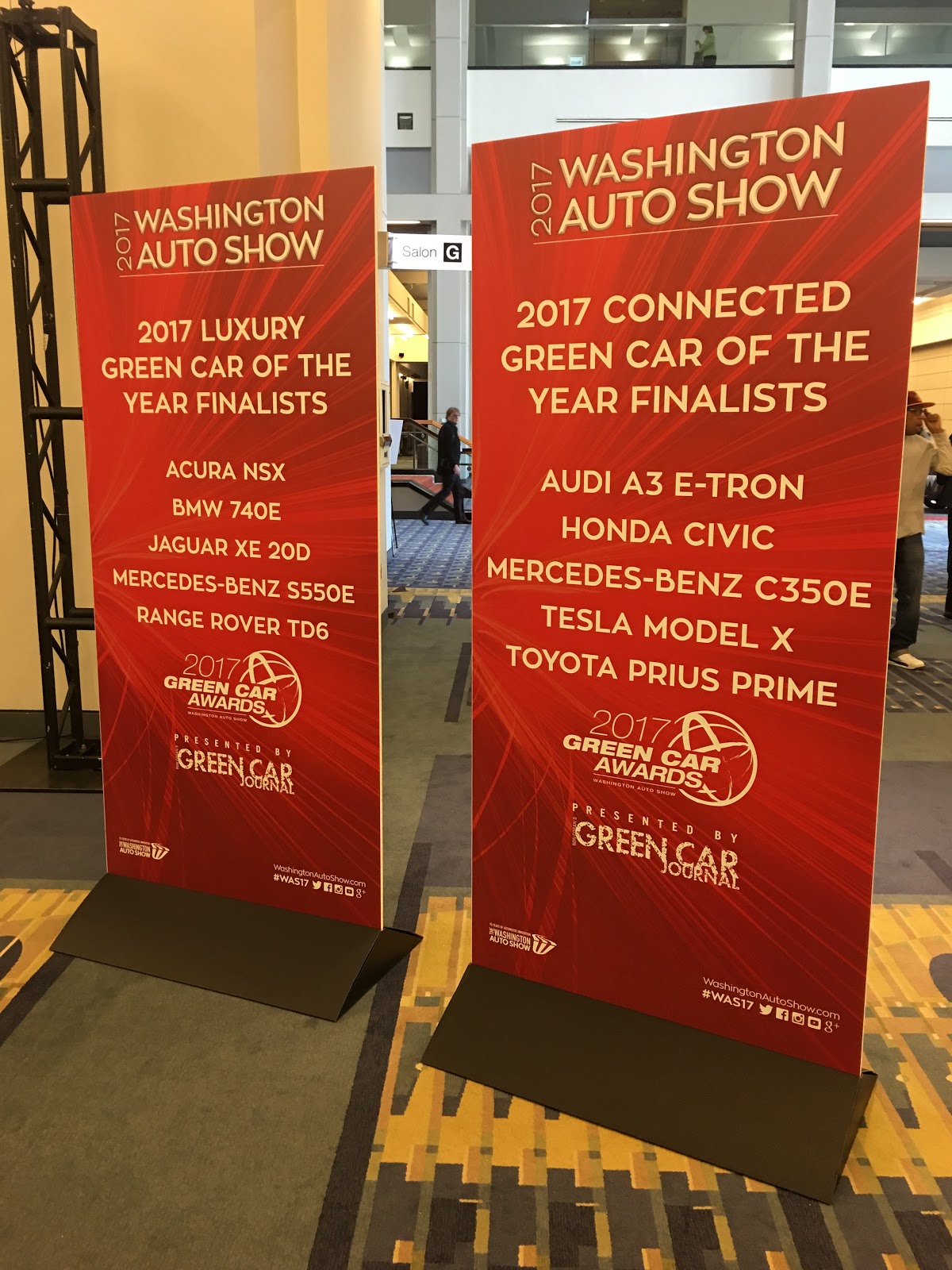
In the 10th year of the awards, Publisher and Editor Ron Cogan staged a media event at The Washington Auto Show to announce the latest winners in three categories. 

The only all-electric vehicle that made the finals was Tesla's elegant Model X, a 7-passenger SUV with Falcon Wing doors and full self-driving hardware.

Inexplicably, Cogan chose the Mercedes-Benz C350e -- a cramped plug-in hybrid sedan -- over the Tesla as winner of the 2017 Connected Green Car of the Year Award.

The Mercedes claims to get 45 MPGe (gas + electric) in the city, but can travel only 11 miles on its battery and electric motor.

Of course, Model X is a zero-emissions vehicle that uses no gasoline, and can travel 295 miles on a full charge.


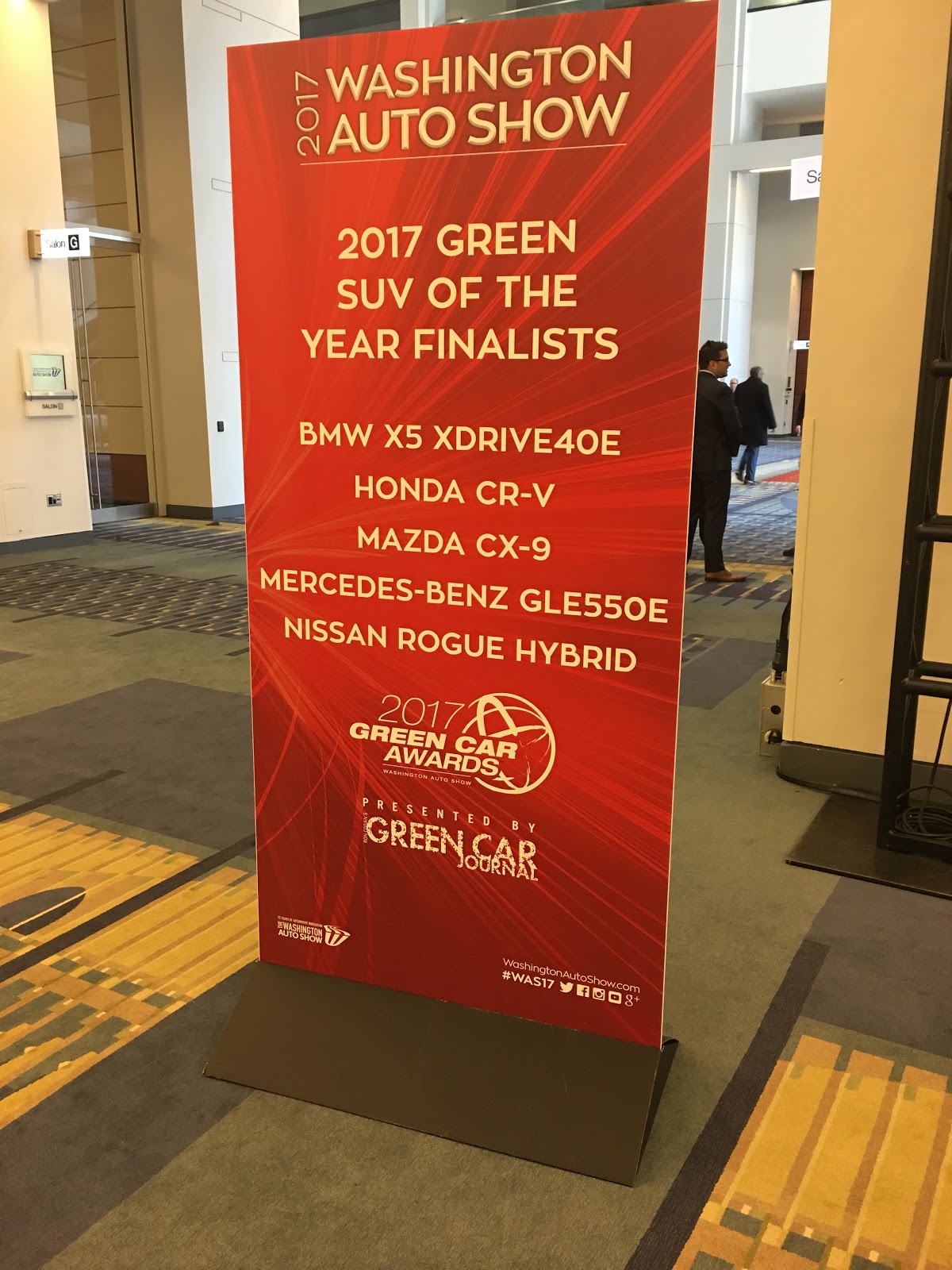
None of the finalists for 2017 Green SUV of the Year are all-electric, and a couple of them aren't even gas-electric hybrids.

BMW and Acura 

Cogan chose the BMW X5 xDrive40e as winner of the Green SUV of the Year Award, and gave the nod for Luxury Green Car of the Year to the Acura NSX hybrid supercar.

Cogan made no mention of the 2017 Chevrolet Bolt EV, which was on display in the Walter E. Washington Convention Center, where the Green Car Awards were announced last Thursday.

He crowned the all-electric Bolt the 2017 Green Car of the Year last November.

For past commentary
 on the auto industry, see:

Saturday, January 28, 2017

Chevrolet Bolt EV costs half the price of a Tesla, but isn't close to being half the car

ELECTRIC AND ELECTRIFIED: Chevrolet now offers the all-electric Bolt EV and the Volt, a plug-in that uses gasoline, but can travel on its battery and electric motors for up to 53 miles, at rear. They are on display at The Washington Auto Show, which runs through Feb. 5.
NO FRUNK: Unlike Tesla's Model S, Model X and the upcoming Model 3, you won't find a trunk in front or frunk under the hood of the front-wheel-drive BOLT EV.


By VICTOR E. SASSON
EDITOR

WASHINGTON, D.C. -- The 2017 Chevrolet Bolt EV has arrived in showrooms, which is great news for the environment.

But despite what you may have read elsewhere, the humble, all-electric hatchback doesn't offer anything close to the refinement or speed of a Tesla.

On a short drive in the nation's capital on Thursday, I heard a lot more mechanical noise from the Bolt's electric motor and transmission than I'm used to in my 2015 Tesla Model S 60.

And a Chevrolet representative in the front seat couldn't explain why the Bolt didn't have Tesla's automatic regenerative braking -- which charges the battery and slows the car when you lift off the accelerator pedal.

Only after I checked the Bolt website did I learn you have to pull a steering-wheel paddle or shift the automatic transmission into "Low" for regenerative braking, which will bring the car to a full stop at a light or sign -- just like in the all-electric BMW i3.

The Bolt I drove and my Tesla are both zero-emission cars and both have a 60 kWh Lithium-ion battery.

But when I punched the Chevy's accelerator pedal from a standing start, the car was noisy, as I've said, and it didn't leap off the line as does my far heavier Model S.

I also noticed some torque steer or pulling on the steering wheel from the front-wheel-drive Bolt.

Of course, the Bolt has an MSRP that is about half of a rear-wheel-drive Tesla Model S 60 ($37,495 v. $71,000), but with the "affordable" Chevy, you get only what you pay for. 

And a smaller Tesla, the upcoming Model 3, with an MSRP of $35,000 before incentives, looks like it will be a far better value than the Bolt EV.

Right now, the Bolt EV is on sale in California and Oregon. Some Chevy dealers in New Jersey and New York are taking orders this month, with delivery scheduled for March.


EL CHEAPO: The Bolt EV's glove box, above, and interior materials scream "cheap" and "just another econobox."
UNATTACHED: The cover over a hidden compartment in the hatch area isn't attached to the car. It might double as a snowboard for a small child.
ROOM FOR LONG LEGS: The 5-door Bolt EV has a high roof line, and with the front passenger seat back as far as it would go, I had plenty of legroom while awaiting my turn to drive.


Bolt v. Model 3

The Bolt comes in two trim levels starting at $36,620 (LT) and $41,780 (Premier) before incentives, and both have a range of 238 miles on a full charge, according to the website.

Neither comes standard with fast-charging capability or such safety features as forward collision alert or low-speed automatic braking.

They are standard on Teslas as well as on Toyotas and other cars that cost less than the Bolt.

Tesla says its 5-passenger Model 3 sedan, with a starting price of $35,000, will begin production in "mid-2017; have a range of 215 miles on a full charge, and do zero to 60 mph in under 6 seconds.

Model 3 also is designed to achieve a 5-star safety rating, the highest possible and the same as in the Model S and Model X.

In addition, Model 3 will be equipped with autonomous-driving features found in more expensive Teslas, including Autopilot, Autosteer and Autopark; and 1,000 miles of free charging at Tesla's proprietary nationwide network of Superchargers.

If you take Bolt on a road trip, Chevy won't provide any free charging.